When people hear the word “core,” they often think about visible abs or aesthetic fitness goals. But true core strength goes far beyond appearance. Your core is the foundation of nearly every movement your body performs from walking and lifting to breathing, running, rotating, balancing, and stabilizing the spine.
In both daily life and athletic performance, a strong and properly functioning core plays a critical role in how efficiently the body moves, how force is generated and transferred, and how resilient the body is against injury. In Pilates specifically, core strength is not treated as an isolated concept. It is the center from which all controlled movement begins.
Joseph Pilates himself referred to this region as the “powerhouse,” emphasizing that strength, control, balance, and movement quality all stem from the center of the body (Pilates & Miller, 1945).
What Is the Core?
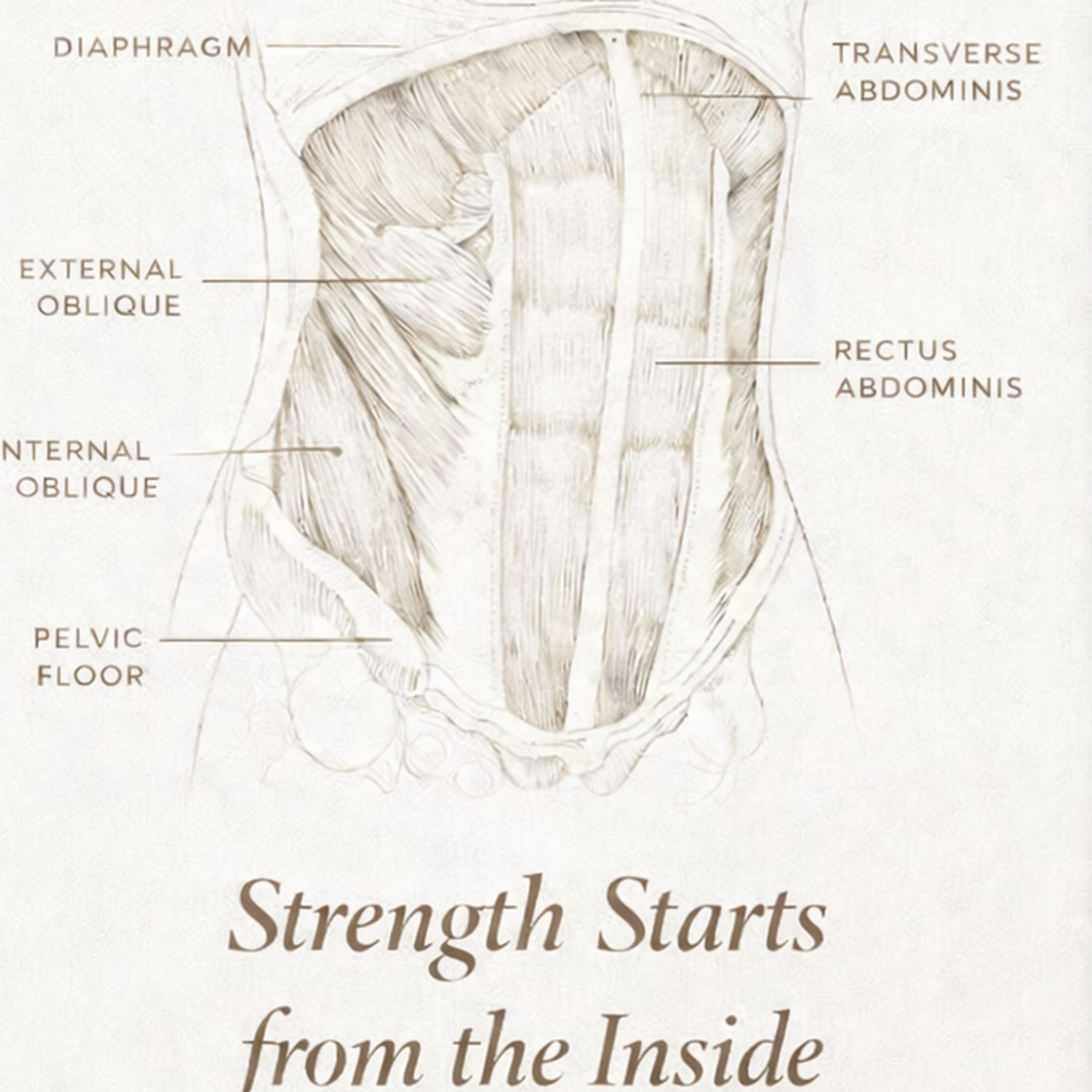
The core is not just one muscle. It is an integrated system of muscles that work together to stabilize the spine, pelvis, and trunk while allowing movement to occur efficiently and safely.
The primary muscles of the core include:
• Rectus Abdominis
• Transverse Abdominis
• Internal and External Obliques
• Multifidus
• Diaphragm
• Pelvic Floor Muscles
• Erector Spinae
• Hip Stabilizers including the glutes and deep hip rotators
These muscles function together as a dynamic stabilization system that supports posture, breathing, spinal alignment, balance, and movement control (Akuthota & Nadler, 2004).
The Rectus Abdominis: Flexion and Trunk Control
The rectus abdominis is the most commonly recognized abdominal muscle and is often referred to as the “six-pack” muscle. It runs vertically along the front of the abdomen and primarily functions to flex the trunk forward, stabilize the pelvis, and assist with posture.
This muscle becomes active during movements such as rolling up, curling the torso, and controlling spinal flexion. In Pilates, the rectus abdominis works concentrically and eccentrically during exercises that emphasize articulation and control of the spine.
The Transverse Abdominis: The Body’s Natural Corset
The transverse abdominis is the deepest abdominal muscle and one of the most important stabilizers in the body. It wraps horizontally around the torso like a corset and helps create intra-abdominal pressure that stabilizes the lumbar spine and pelvis.
Research has shown that activation of the transverse abdominis is critical for spinal stability and may play a role in reducing low back pain (Hodges & Richardson, 1996).
The Obliques: Rotation, Stability, and Power Transfer
The internal and external obliques sit along the sides of the trunk and are heavily involved in rotational movement, lateral flexion, spinal stabilization, and force transfer between the upper and lower body.
These muscles become particularly important in sports and athletic performance where rotational power is essential — including golf, tennis, baseball, volleyball, swimming, and running.
The Multifidus and Deep Spinal Stabilizers
The multifidus muscles are small but critically important muscles that run along the spine. Their primary role is spinal stabilization and segmental control of the vertebrae.
Research has demonstrated that dysfunction of these muscles is associated with chronic low back pain and spinal instability (MacDonald et al., 2006).
Breathing, the Diaphragm, and Core Function
Breathing mechanics are deeply connected to core function. The diaphragm is not only the primary muscle of respiration but also a major contributor to core stabilization.
When the diaphragm, transverse abdominis, pelvic floor, and deep spinal stabilizers work together properly, they create optimal pressure regulation and trunk stability (Kolar et al., 2012).
Core Strength and Low Back Pain
One of the most researched areas involving core strength is its relationship to low back pain. Weakness, poor motor control, and lack of endurance in the core musculature are frequently associated with lumbar instability and chronic discomfort.
Core-focused exercise programs, including Pilates-based training, have been shown to improve pain, functional movement, and quality of life in individuals with chronic low back pain (Wells et al., 2014).
The Role of Core Strength in Athletic Performance
Athletic movement depends heavily on the ability to transfer force efficiently between the lower and upper body. The core acts as the transmission system for this force transfer.
Whether sprinting, jumping, throwing, rotating, or changing direction, athletes rely on core stability and coordination to maximize power output while minimizing energy leaks and injury risk.
Core Strength in Everyday Life
Core strength is not only important for athletes. It affects nearly every aspect of daily living.
Simple activities such as carrying groceries, picking up children, climbing stairs, standing for long periods, and maintaining good posture all rely on trunk stability and coordinated movement control.
As people age, maintaining core strength becomes increasingly important for balance, mobility, independence, and injury prevention.
Why Pilates Is So Effective for Core Development
Unlike traditional fitness methods that often isolate muscles or prioritize repetitive high-speed movement, Pilates trains the core as part of an integrated movement system.
Pilates emphasizes controlled movement, proper breathing, alignment, stability, mobility, precision, coordination, and mind-body awareness.
Rather than simply creating muscular fatigue, Pilates teaches the body how to move more efficiently.
At P3, this is one of the reasons we emphasize coaching, correction, and movement quality over simply moving faster or performing more repetitions. True core strength is not just about feeling the burn, it is about creating a stronger, more stable, and more resilient body.
Core strength is one of the most fundamental components of human movement and long-term physical health. It influences posture, balance, spinal support, breathing, athletic performance, and injury prevention.
In Pilates, the core is not treated as an accessory muscle group. It is the center of movement itself.
When the core functions properly, the body moves better, performs better, and feels better.
References
Akuthota V, Nadler SF. Core strengthening. Archives of Physical Medicine and Rehabilitation. 2004.
Hodges PW, Richardson CA. Inefficient muscular stabilization of the lumbar spine associated with low back pain. Spine. 1996.
Joseph Pilates & William Miller. Return to Life Through Contrology. 1945.
Kibler WB, Press J, Sciascia A. The role of core stability in athletic function. Sports Medicine. 2006.
Kolar P et al. Stabilizing function of the diaphragm. Journal of Applied Physiology. 2012.
MacDonald DA et al. Multifidus and lumbar stability. Spine. 2006.
Wells C et al. Effectiveness of Pilates exercise in treating people with chronic low back pain. PLOS One. 2014.